 admin
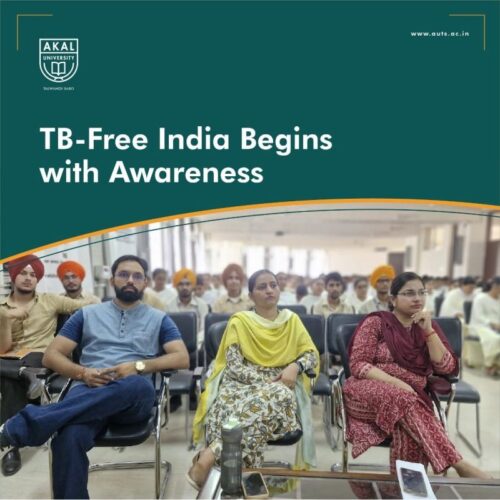
adminA disease can be fully treatable and still remain a major public health challenge when awareness, early diagnosis, and social acceptance are missing. That is exactly the gap Akal University, Talwandi Sabo, set out to address on 25 August 2026, hosting a TB-Free India awareness session for 350 students and faculty members through a live viewing of the UGC Chetna Series.
The session, titled “TB Mukt Bharat Abhiyaan: Creating Awareness for a TB-Free India,” brought national-level expertise directly into the university, giving students access to information that goes far beyond what a textbook or classroom lecture typically covers.
What the TB-Free India Awareness Session at Akal University Covered
The session featured Dr. Shobini Rajan, Deputy Director General (TB), Central TB Division, Ministry of Health & Family Welfare, Government of India, who walked students through TB symptoms, transmission, prevention, early diagnosis, and the importance of completing treatment on time. These are details that matter well beyond the immediate audience in the room — students carry this knowledge home, to their families, and into the communities they come from.
This is precisely why TB-Free India awareness at Akal University was designed as a large, cross-departmental initiative rather than a niche academic session. Reaching 350 students in a single sitting meant reaching 350 potential channels of accurate, credible health information flowing back into rural and semi-urban households across the region.
Why the Real Message Went Beyond Medical Facts
Perhaps the most important message from the session had little to do with clinical detail. Fighting TB also means fighting the stigma that still surrounds it. Even when treatment is accessible, fear of social judgement often keeps people from seeking diagnosis early or disclosing their condition to those around them.
Educational institutions have a distinct role to play here — not only in producing informed students, but in preparing young people to carry credible, stigma-free health information back into their families and communities. This is the deeper objective behind TB-Free India awareness at Akal University: building a generation of students who can speak about TB with facts instead of fear.
How Akal University Structured This TB-Free India Awareness Initiative
The session was organised under the direction of the DSW Office, working in coordination with the Departments of Life Sciences and Education. Bringing these departments together reflects a deliberate approach: TB awareness is treated not purely as a health topic, but as a subject that touches science, education, and social responsibility at once.
That structure reinforced a simple, memorable idea running through the entire session — awareness saves time, early action saves lives, and empathy helps communities heal.
Why Student-Led Health Awareness Matters for a TB-Free India
As India works toward the national vision of a TB-Free India, informed and responsible young citizens can become powerful partners in that effort. Sessions like this one at Akal University are a reminder that public health goals are not achieved through policy and medicine alone — they depend on institutions willing to put credible information directly in front of the next generation, and trust them to carry it forward.
Explore Student Life and Initiatives at Akal University
This TB-Free India awareness session reflects a broader institutional commitment at Akal University to student engagement that extends beyond academics into public health, civic responsibility, and community impact.
To learn more about student initiatives and programmes at Akal University, visit auts.ac.in.
Frequently Asked Questions
1. What was the TB-Free India awareness session at Akal University?
A live viewing of the UGC Chetna Series on TB Mukt Bharat Abhiyaan, held on 25 August 2026 for 350 students and faculty.
2. Who spoke at the TB-Free India awareness session?
Dr. Shobini Rajan, Deputy Director General (TB), Central TB Division, Ministry of Health & Family Welfare, Government of India.
3. What topics were covered in the session?
TB symptoms, transmission, prevention, early diagnosis, and timely completion of treatment.
4. Which departments organised this TB awareness initiative?
The DSW Office, in coordination with the Departments of Life Sciences and Education at Akal University.
5. Why is fighting stigma important in TB awareness efforts?
Stigma often stops people from seeking early diagnosis or treatment, so reducing it is as vital as sharing medical facts.







Add comment