 admin
adminA pledge. A poster. A point of view. That is how the Department of Liberal Arts and NSS at Akal University marked Rashtriya Sadbhavna Diwas this year — with substance, not ceremony for ceremony’s sake.
Rather than treating the day as a formality, the university built an entire evening around it: context, creation, dialogue, and a collective commitment that brought students and faculty together on equal footing.
How Akal University Set the Tone for Rashtriya Sadbhavna Diwas
The observance opened with NSS Program Officer Akashbir Singh setting the context for the day — its legacy, and why national integration is every student’s responsibility, not simply a chapter confined to history books. That framing mattered. It positioned the rest of the evening not as a one-off activity, but as a continuation of something students are expected to carry with them well beyond the campus.
Turning Ideas Into Action – The Real Work Behind Rashtriya Sadbhavna Diwas at Akal University
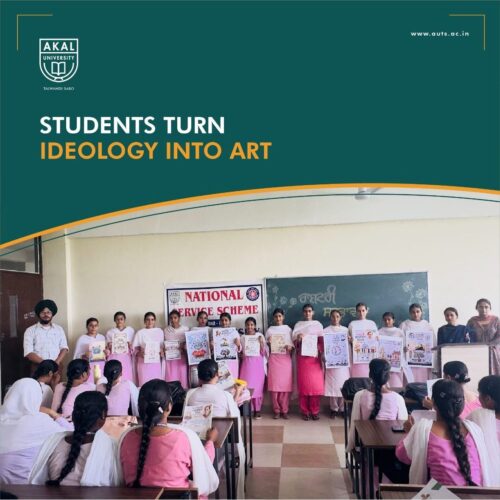
Once the context was set, the real work began. Students translated ideas of unity and coexistence into digital posters — designed, printed, and presented in an open forum where every creative choice had to be explained and defended. This was not a passive art exercise. Students were expected to articulate why a colour, a symbol, or a phrase belonged in a piece meant to represent national harmony, turning the poster-making process into an exercise in critical thinking as much as design.
Faculty mentors Manpreet Kaur and Amritpal Kaur played a central role in this process. Rather than simply supervising submissions, they pushed students to interrogate what their art was actually communicating — a small but telling detail about how Akal University approaches values education: not as a checklist, but as a genuine intellectual exercise.
The Sadbhavna Pledge – How Rashtriya Sadbhavna Diwas at Akal University Closed the Evening
The evening closed with a moment that brought the entire community together. Students and faculty, standing as one assembly, took the Sadbhavna Pledge — a shared commitment to mutual respect, emotional integrity, and a campus free of discord. It was a deliberate move to make the pledge a collective act rather than a symbolic gesture read out to a passive audience.
Why This Observance Reflects How Akal University Approaches Education
This kind of programming is a reminder of a broader institutional philosophy: at Akal University, character-building is not treated as an add-on to academics — it is treated as the point of education itself. Rashtriya Sadbhavna Diwas became an opportunity to combine civic learning, creative expression, and open dialogue into a single, cohesive experience, rather than three separate, disconnected activities.
For a university built on values-based education, days like this are not exceptions to the academic calendar. They are proof of what that philosophy looks like in practice.
Explore Student Life at Akal University
Moments like this Rashtriya Sadbhavna Diwas observance are part of a larger culture at Akal University — one where students are consistently pushed to think, question, and stand for something beyond the classroom.
To learn more about student life and programmes at Akal University, visit auts.ac.in or call 1800-2020-100.
Frequently Asked Questions
1. What is Rashtriya Sadbhavna Diwas?
It is a national observance dedicated to communal harmony, unity, and national integration.
2. How did Akal University mark Rashtriya Sadbhavna Diwas this year?
Through an opening address, a student poster presentation on unity and coexistence, and a collective Sadbhavna Pledge.
3. Who organised the Rashtriya Sadbhavna Diwas programme at Akal University?
The Department of Liberal Arts and the NSS unit of Akal University, Talwandi Sabo.
4. What is the Sadbhavna Pledge?
A shared commitment taken by students and faculty to mutual respect, emotional integrity, and a discord-free campus.
5. Who guided students during the poster presentation activity?
Faculty mentors Manpreet Kaur and Amritpal Kaur, alongside NSS Program Officer Akashbir Singh.







Add comment